 ultimate-guide
Layer: A Clear Guide to Its Meanings and Uses
Last Updated: November 5, 2026
Quick Summary
A layer is a single thickness of material that sits over, under, or between other thicknesses, and the word describes both the physical sheet and the position it occupies. That dual meaning explains why the term shows up everywhere from a cliff face to a design file.
- The word entered English from the Middle English leyer, tracing back to the Latin lectus, meaning a bed or couch.
- Use stratum for geology, coating or film for thin applied surfaces, tier for hierarchy, sheet for a flat expanse, and ply for textiles.
- The standard clothing system has three parts: a base layer, a mid layer, and an outer shell.
- Skin has three principal layers: the epidermis, the dermis, and the hypodermis, or subcutaneous layer.
- In GIS, vector layers store points, lines, or polygons, while raster layers store a grid of cells each holding a value.
Table of Contents
- Layer Definition: What the Word Actually Means
- Layer Synonym: Words That Fit Different Contexts
- Layers in Nature: Rock, Soil, Water, and Temperature
- Layer Clothing: How to Build Warmth and Flexibility
- Layer Skin: The Anatomy of the Body's Outer Surface
- Layers in Maps and Geographic Information Systems
- Digital Layers in Software, Design, and Workflows
- Choosing the Right Layer for Your Next Compliance Project
- Frequently Asked Questions
Layer Definition: What the Word Actually Means
A layer is a single thickness of material that sits over, under, or between other thicknesses, and the word describes both the physical sheet and the position it occupies.
The word entered English from the Middle English leyer, a thing that lies, tracing back to the Latin lectus, meaning a bed or couch. The root sense is simple: something laid down. A layer is not a stack, not a pile, and not a mixture.
That definition holds across every context below: a rock layer, a clothing layer, a map layer, and a software layer all sit on or against something else, can be separated from what surrounds them, and can be described by thickness, position, and function.
Layer Synonym: Words That Fit Different Contexts
Choosing a synonym for layer depends on what is being layered. Use stratum for geology, coating or film for a thin applied surface, tier for hierarchy, sheet for a single flat expanse, and ply for textile or paper. The wrong one reads as imprecise.
Here is how the common alternatives sort out:
- Stratum: a natural or geological band, usually one of many in a sequence
- Coating: a layer applied to a surface for protection or appearance
- Film: an extremely thin layer, often of liquid or polymer
- Sheet: a flat layer of uniform material, handled as a unit
- Tier: a layer in a ranked or stacked structure, often abstract
- Ply: one of several bonded layers in fabric, plywood, or tissue
- Slice: a layer cut through something, emphasizing cross-section
- Level: a layer defined by height or rank rather than material
In practice, most people reach for "layer" to signal separability, and "level" to signal hierarchy. A building has levels. A painted wall has layers.
The right synonym depends on what is being layered, so here is how the common alternatives sort out.
| Synonym | Best for | Meaning |
|---|---|---|
| Stratum | Geology | A natural or geological band in a sequence |
| Coating | Applied surfaces | A layer applied for protection or appearance |
| Film | Very thin layers | An extremely thin layer, often liquid or polymer |
| Sheet | Flat material | A flat layer of uniform material handled as a unit |
| Tier | Hierarchy | A layer in a ranked or stacked structure |
| Ply | Textiles and paper | One of several bonded layers in fabric, plywood, or tissue |
| Slice | Cross-sections | A layer cut through something, emphasizing cross-section |
| Level | Height or rank | A layer defined by height or rank rather than material |
Layers in Nature: Rock, Soil, Water, and Temperature
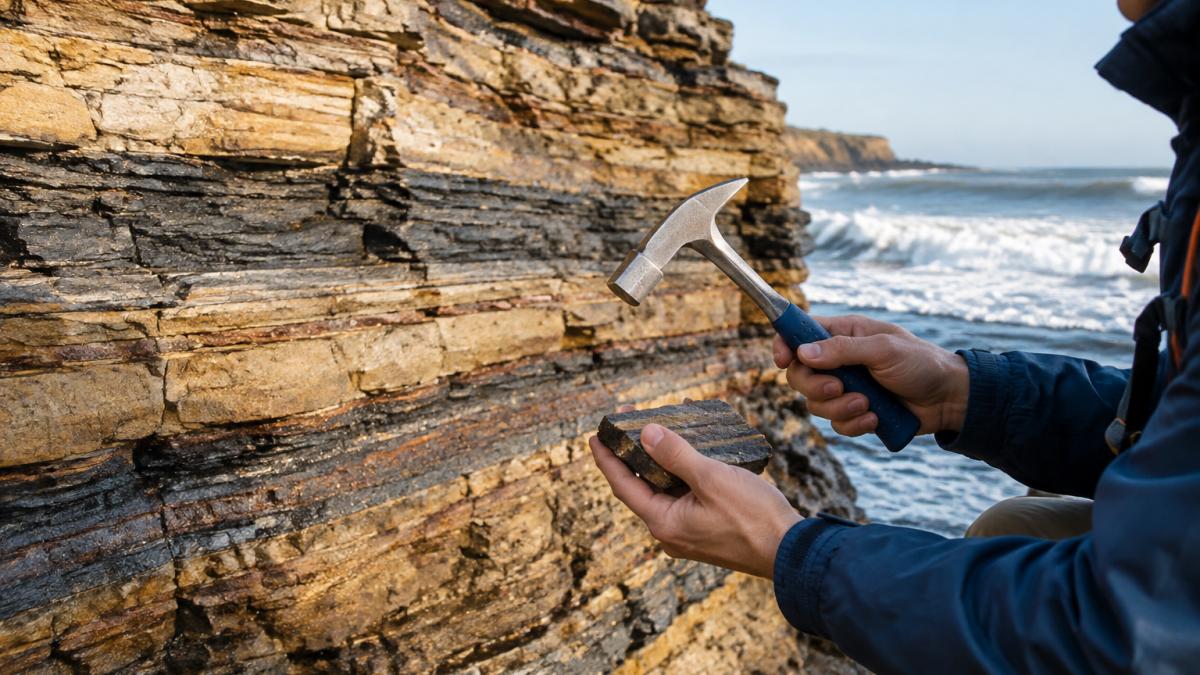
Natural layering is the clearest illustration of the concept, because the layers are visible and measurable.
Soil layers, called horizons, run from organic topsoil down through subsoil to bedrock.
The practical takeaway: in natural systems, a layer is defined by a boundary where a property changes sharply. Find the boundary, and you have found the layer.
Layer Clothing: How to Build Warmth and Flexibility
Layering clothing works by trapping insulating air in multiple adjustable shells rather than one thick garment, so you can add or remove warmth as conditions change. The standard system has three parts: a base layer that moves moisture off the skin, a mid layer that holds warmth, and an outer shell that blocks wind and rain.
Most people get this wrong in one specific way: they buy an expensive outer shell and wear a cotton t-shirt underneath. Cotton holds moisture against the body, exactly what the base layer exists to prevent.
- Base layer: merino wool or a synthetic knit, fitted, never cotton
- Mid layer: fleece or a light synthetic fill for warmth
- Outer shell: windproof and waterproof, sized to fit over the other two
The benefit is range. One three-part system covers more conditions than any single jacket, and you adjust it by removing a layer rather than changing your whole outfit.
Layer Skin: The Anatomy of the Body's Outer Surface
Skin has three principal layers, each doing a different job. The epidermis is the thin outer layer that forms the waterproof barrier. The dermis beneath it holds collagen, elastin, blood vessels, nerves, and glands. The hypodermis, or subcutaneous layer, stores fat and connects skin to muscle and bone.
Thickness varies enormously by site. Skin on the soles and palms is far thicker than on the eyelids, which is why the same product or procedure behaves differently depending on where it is applied.
Layers in Maps and Geographic Information Systems
A map layer is a single dataset drawn over a shared geographic base, so several kinds of information can be viewed in combination without being merged into one file.
Two layer types. Vector layers store discrete features as points, lines, or polygons (a fire hydrant, a road centerline, a parcel boundary). Raster layers store a grid of cells, each holding a value (elevation, temperature, satellite imagery). Most real maps combine both: a raster basemap underneath vector layers for roads and labels.
The attribute table. Every vector layer carries a table of attributes, one row per feature, one column per property.
Layer order and scale. Layers render from the bottom of the table of contents upward, so a filled polygon layer above a line layer will hide the lines.
Overlay analysis. Because layers are separate datasets sharing a coordinate system, they can be combined mathematically: intersect two polygon layers to find where zoning and floodplain overlap, or clip a road layer to a watershed boundary. This overlay operation is the GIS equivalent of compositing in design software.
Common layer types in a typical municipal GIS:
- Basemap (raster imagery or street map)
- Parcels and ownership boundaries (vector polygons)
- Zoning and land use (vector polygons)
- Streets and centerlines (vector lines)
- Water, sewer, and utility networks (vector lines and points)
- Elevation and terrain (raster)
- Address points and landmarks (vector points)
Field data and room data follow the same logic in building work. A floor plan is a base layer, and construction elements, furniture, fixtures and equipment, and the punch list are added as separate layers on top.
Digital Layers in Software, Design, and Workflows
In design and document software, a layer is an independent plane that holds its own elements and can be moved, hidden, locked, reordered, or blended without altering anything on the other planes.
Stacking order (z-order). Layers are drawn from the bottom of the stack upward, so a layer higher in the list covers whatever sits below it.
Visibility and locking. Every mainstream tool lets you toggle a layer's eye icon to hide it and a lock icon to prevent accidental edits.
Here is how the same concept appears across common tools:
- Image editing (Photoshop, GIMP, Affinity Photo): raster layers, adjustment layers, text layers, smart objects, and layer masks.
- Vector and UI design (Illustrator, Figma, Sketch): artboards containing nested layers and groups, with constraints and auto-layout applied per layer.
- Page layout (InDesign, Publisher): layers that separate master-page elements, body text, and images so one can be hidden or exported independently.
- Video and motion (After Effects, Premiere): layers stacked on a timeline, where each layer's in/out points and blend mode determine the composite.
- CAD and BIM (AutoCAD, Revit): drawing layers (AutoCAD) and view filters/worksets (Revit) that isolate disciplines such as structure, mechanical, and electrical.
- Documents and spreadsheets: named ranges, sheet tabs, and grouped rows behave as lightweight layers that separate concerns within one file.
Two properties make digital layers valuable in every one of these tools. First, non-destructive editing: you can change one layer and leave the rest untouched, which is why professionals rarely flatten a file until final export. Second, compositing: stacked layers combine according to rules you control, so a single file can hold many versions of an idea.
Workflows layer the same way. If your team is building that kind of layered documentation, our AI design controls service shows how the digital workflow is structured, and our software services cover compliance support for layered software development.
Watch out: the most common digital-layer mistake is not naming layers. A file with forty layers called "Layer 1" through "Layer 40" is functionally unlayered, the organization exists on paper but not in practice.
Choosing the Right Layer for Your Next Compliance Project
The value of thinking in layers is that it lets you separate concerns that are genuinely separate, and the trap is separating things that are not. In a medical device compliance project, the layers are real: a quality management system layer, a risk management layer, a design controls layer, and a submission layer. Each has its own standard, evidence, and review cycle.
Where teams get into trouble is treating those layers as independent. They are not. A risk management file that does not trace into design inputs is a finding waiting to happen, and a quality system that exists on paper but not in the workflow will not survive an audit.
If you are planning a project and unsure which layer applies to your device, our quality system regulation guidance explains how the QMS layer maps to device classification, and our medical device quality assurance page shows how the QA layer fits into a project plan. For the risk management layer specifically, our ISO 14971 risk management service covers how to build it so the traces hold.
Frequently Asked Questions
What is the meaning of layer?
A layer is a single thickness of material that sits over or under another, or a distinct level within a larger structure. The word comes from the Latin 'lavare' through Old French, meaning a bed or stratum. You see it in geology (rock layers), clothing (base layer, mid layer, shell), biology (skin layers), mapping (GIS layers), and software (design layers). In every case, the core idea is the same: something stacked, spread, or arranged over something else.
Is it layer or lair?
They are different words. 'Layer' refers to a thickness, stratum, or level of material, and it is the standard spelling in science, fashion, and software. 'Lair' means a wild animal's den or a secret hideout. The confusion comes from similar pronunciation in some accents. If you mean a stacked sheet, level, or coating, use 'layer'. If you mean an animal's resting place, use 'lair'.
What are the synonyms of layer?
The best synonym depends on context. In geology and general structure, use 'stratum' or 'strata'. In construction and materials, 'sheet', 'coating', or 'film' works. In digital design and mapping, 'level' or 'overlay' is common. In clothing, 'base layer', 'mid layer', and 'shell' are specific terms rather than plain synonyms. In figurative speech, 'tier' or 'level' fits. Choose the word that matches your reader's field so the meaning stays clear.
What does layer mean in GIS and geography?
In geographic information systems, a layer is a themed set of spatial data stacked over a base map. Each layer holds one type of feature, such as roads, rivers, property boundaries, or temperature readings. Analysts turn layers on and off to compare data, and the map legend explains what each layer shows. This is why GIS teams talk about field data, room data, floor plans, and building layers when they plan a project or track a punch list.
Compliance projects fail at the seams between layers far more often than inside any single one. E & E Medicals and Consulting works with regulatory affairs teams to map those seams before they become findings, drawing on FDA regulatory expertise, quality management specialization, and ISO compliance consulting built specifically for the medical device industry. Get started with E & E Medicals and Consulting and build a submission that holds together under review.