 comparison
FreyR Solutions Alternatives for Compliance
Table of Contents
- Why Medical Device Companies Switch From FreyR Solutions
- Top Alternatives to FreyR Solutions for Regulatory Compliance
- Comparison Table: Key Features and Capabilities
- FDA Regulatory Consulting Services: What to Look For
- ISO 13485 Compliance Consulting and Implementation Support
- Medical Device Quality Management System Implementation
- How to Choose the Right Compliance Partner for Your Organization
- Implementation Timeline and Migration Complexity
- Frequently Asked Questions
Last Updated: October 7, 2026
Why Medical Device Companies Switch From FreyR Solutions
Medical device manufacturers face a critical decision when their compliance platform stops delivering. Outdated workflows, limited regulatory intelligence, or a quality management system that doesn't scale all create risk.
The real problem isn't always the platform. It's misalignment between what you need and what you're getting. A startup's compliance automation requirements look nothing like a mid-sized manufacturer's navigating FDA 510(k) submissions across regions. When your business outgrows its tools, or they fail to address challenges like AI/ML device governance or EU MDR complexity, switching becomes inevitable.
At E & E Medicals and Consulting, we provide guidance to medical device companies evaluating compliance alternatives. Successful switchers share one trait: they understand exactly what they need before choosing. They assess implementation timelines, regulatory intelligence, quality management system integration depth, and whether the platform supports their specific submission pathway.
This guide covers the alternatives to FreyR Solutions: what to look for, how platforms compare, and how to avoid mistakes that slow regulatory submissions and audit readiness.
Top Alternatives to FreyR Solutions for Regulatory Compliance
The compliance software landscape has shifted. Modern platforms combine automated evidence collection, real-time regulatory monitoring, and integrated quality management workflows. The best choice depends on your company size, submission complexity, and whether you need industry-specific depth or broad coverage.
E & E Medicals and Consulting: FDA Regulatory Expertise and Quality Management
E & E Medicals and Consulting combines FDA regulatory consulting with hands-on quality management system implementation. Unlike software-only platforms, our approach integrates regulatory strategy with operational compliance, so your team doesn't just manage documents, they understand and execute the regulatory pathway.
Our FDA regulatory expertise covers 510(k) submissions, De Novo pathways, PMA applications, and IDE protocols. We also provide ISO 13485 consulting that goes beyond audit checklists, helping you design systems that work for your organization's size and complexity.
Our regulatory intelligence is informed by real-time tracking of guidance updates. When the FDA releases new expectations around software validation or AI governance, your team knows what it means for your submission timeline.
What sets E & E Medicals and Consulting apart is our focus on the regulatory value chain. We help you navigate the entire pathway from product conception through post-market compliance, preventing costly delays for companies serious about market access.
Vanta: Automated Compliance and Audit Readiness
Vanta automates security compliance across frameworks like SOC 2, ISO 27001, and HIPAA. If your primary concern is security certification speed, its guided workflows and continuous monitoring deliver.
The platform integrates with over 200 cloud tools including AWS, Google Workspace, and Slack, meaning less manual evidence collection and weeks of saved work for companies racing to certification.
However, Vanta's security compliance strength doesn't extend to medical device-specific requirements. If you're navigating FDA submissions, EU MDR compliance, or ISO 13485 quality management, Vanta handles the security layer but not the full regulatory submission lifecycle. It's best as part of a broader compliance strategy, not your primary regulatory platform.
Healthicity: Healthcare-Specific Regulatory Compliance
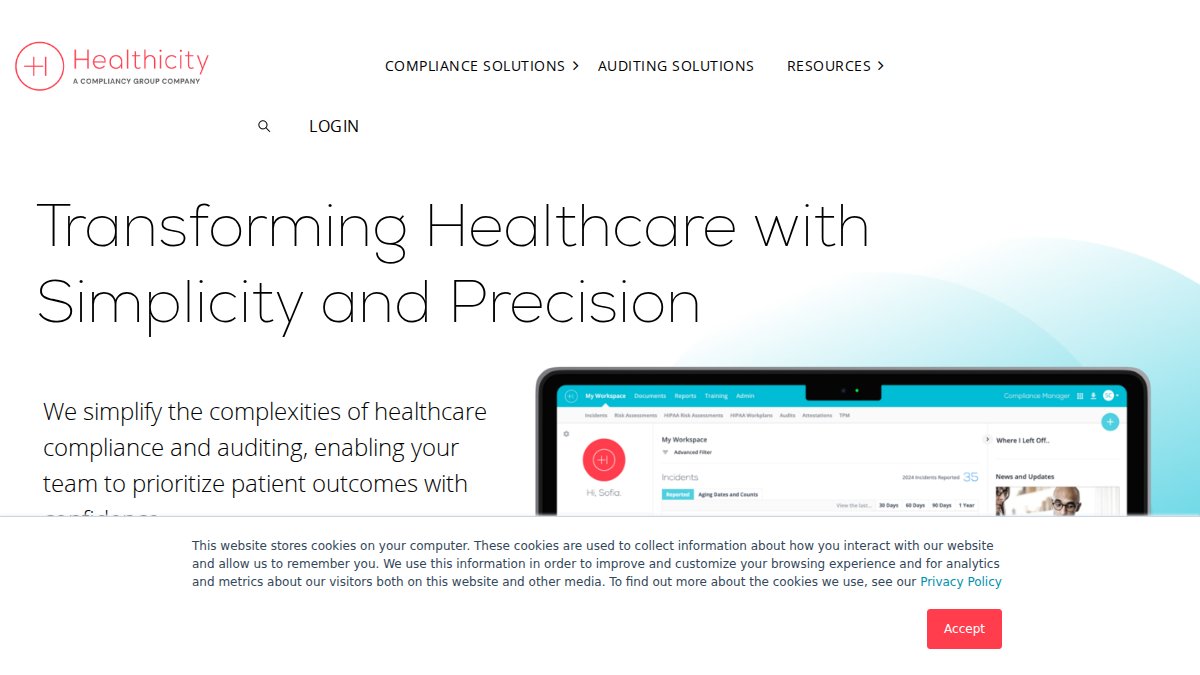
Healthicity focuses on healthcare organizations managing HIPAA compliance, incident reporting, and audit trails, with automated risk assessment and policy management modules built for healthcare workflows.
For organizations needing specific HIPAA support, Healthicity's industry focus provides clarity, and its monthly pricing offers predictability compared to enterprise platforms requiring custom quotes.
The limitation is scope. Healthicity doesn't address the full range of medical device regulatory requirements, particularly FDA submission management, design controls, or ISO 14971 risk management integration. If your needs extend beyond HIPAA into device-specific FDA pathways, you'll need additional tools or consulting support.
Sprinto: Fast-Track Security Certification and Compliance
Sprinto helps fast-growing companies achieve security certifications quickly, with guided implementation workflows for SOC 2, ISO 27001, and HIPAA, plus real-time compliance monitoring and employee security training.
The user-friendly interface appeals to companies without dedicated compliance staff. For SaaS startups needing rapid certification, Sprinto's speed-to-compliance is genuinely valuable. The API-based integrations with cloud providers simplify evidence collection.
Like Vanta, Sprinto's strength lies in security compliance automation rather than medical device regulatory pathways. For manufacturers, it addresses the security and data protection layer but doesn't cover FDA submissions, quality management systems, or device-specific regulatory intelligence.
Comparison Table: Key Features and Capabilities
| Feature | E & E Medicals and Consulting | Vanta | Healthicity | Sprinto |
|---|---|---|---|---|
| FDA Regulatory Expertise | Yes | No | No | No |
| ISO 13485 Consulting | Yes | No | No | No |
| Design Controls & V&V Support | Yes | No | No | No |
| Security Compliance Automation | Integrated | Yes | Limited | Yes |
| HIPAA Support | Yes | Yes | Yes | Yes |
| Real-Time Regulatory Monitoring | Yes | No | No | No |
| Quality Management System Integration | Yes | No | Yes | No |
| Implementation Timeline Support | Yes | No | No | No |
| EU MDR Compliance Guidance | Yes | No | No | No |
| Best For | Medical device manufacturers, regulatory submissions, QMS implementation | Fast-growing SaaS companies, security certifications | Healthcare providers, HIPAA compliance | SaaS startups, rapid ISO/SOC 2 certification |
FDA Regulatory Consulting Services: What to Look For
Choosing an FDA regulatory consulting partner requires understanding what you actually need. Not all firms approach regulatory strategy the same way, and the wrong consultant can cost you months and significant resources.
Look for consulting partners with FDA meeting experience. Consultants who understand how the agency thinks, which questions lead to productive dialogue, and which signal weak submissions, can provide valuable insight. That insight can't be replicated by software.
Your consulting partner should demonstrate specific experience with your submission pathway. A 510(k) requires different expertise than a De Novo or PMA. If a firm claims equal expertise across all pathways, they likely lack depth in any. Ask for examples in your specific category.
Real-time regulatory intelligence matters more than most companies realize. The FDA issues guidance updates, warning letters, and policy changes constantly. Your partner should track these and translate them into actionable implications for your product strategy, shaping your development timeline continuously rather than quarterly.
Quality management system implementation should be practical, not theoretical. Some consultants hand you an ISO 13485 framework and tell you to build around it.
ISO 13485 Compliance Consulting and Implementation Support
ISO 13485 certification separates companies that understand quality from those that just check boxes. The standard requires a documented quality management system covering design controls, risk management, document control, and corrective action.
The implementation timeline depends on your starting point. Companies going it alone often take longer and encounter unanticipated audit findings.
Your consulting partner should help you integrate ISO 13485 with FDA requirements. These aren't separate systems: design controls under ISO 13485 support FDA design history file requirements, and ISO 14971 risk management feeds into FDA submissions. A consultant who understands both frameworks builds unified systems rather than parallel processes.

Documentation is where most companies struggle. ISO 13485 requires traceability across your entire product lifecycle. Your consultant should help establish document control systems that track and justify every design change, risk assessment update, and supplier change. This sounds simple until you implement it across a real organization.
Medical Device Quality Management System Implementation
Building a quality management system from scratch requires strategic thinking about your actual needs. A startup with one product has different QMS requirements than a manufacturer with a portfolio spanning multiple device classes. The goal isn't maximum complexity, it's the right complexity.
Start with your regulatory pathway. A 510(k) device requires different QMS depth than a PMA device, so your QMS should be proportionate to your regulatory risk. Many companies waste resources building systems for high-risk devices when a leaner approach is justified.
Your QMS must cover design controls, risk management, supplier management, production and process controls, corrective and preventive actions, and complaint handling. Each element requires documentation, training, and ongoing management.
Design controls deserve special attention. FDA reviewers scrutinize design history files more than almost any other QMS element. Your process should document design inputs, outputs, review, verification, validation, and changes, creating an audit trail that demonstrates rigorous product development.
Risk management under ISO 14971 integrates into your overall QMS. Device risks span biocompatibility, sterilization, electrical safety, software reliability, and cybersecurity. Your process should identify hazards, estimate risk, implement controls, and verify effectiveness, evolving as your product and market change.
How to Choose the Right Compliance Partner for Your Organization
Selecting a compliance partner differs fundamentally from selecting software. Software can be switched if it doesn't work; a consulting relationship gone wrong costs time, creates regulatory delays, and can damage your FDA relationship. Choose carefully.
Evaluate your partner's track record with companies like yours. Size matters: a consultant experienced with $500M manufacturers may not understand startup resource constraints, and a startup consultant may not grasp multi-site manufacturing or global submissions.
Cultural fit matters more than most companies acknowledge. Your consultant will be embedded in your organization, shaping your regulatory strategy. Friction in communication or problem-solving creates friction across your entire regulatory process.
Ask about their FDA relationship. Do they track guidance updates and warning letters? Can they speak to how the agency's expectations have evolved? A consultant current with FDA thinking brings insights that directly impact submission success.
Pricing transparency matters. Consultants may quote hourly rates, project-based pricing, or retainers for ongoing support.
Implementation Timeline and Migration Complexity
Moving from one compliance platform or consulting approach to another creates operational disruption if not managed carefully.
The migration timeline depends on your current documentation state, product portfolio complexity, whether you're changing platforms or adding consulting support, and your team's capacity to absorb the change.
For companies migrating from FreyR Solutions to a new platform, expect a four-to-twelve-week transition depending on data volume and integration requirements.
Data migration is the operational bottleneck. Regulatory submissions, quality documentation, audit records, and compliance evidence must transfer cleanly.
Your team needs training on new systems and processes.
The best approach is phased implementation: start with your highest-priority submissions or audit requirements, get those working before attempting full migration, and give your team time to adapt.
Budget for implementation support. Whether implementing new software or engaging consulting services, the first three months require more resources than steady-state operations.
Switching compliance platforms or consulting partners affects your entire regulatory timeline.
At E & E Medicals and Consulting, we help medical device manufacturers navigate this transition with minimal disruption.
Get started with E & E Medicals and Consulting and turn regulatory compliance from a bottleneck into a competitive advantage.
Frequently Asked Questions
What are the best alternatives to FreyR Solutions for FDA regulatory consulting?
E & E Medicals and Consulting specializes in FDA regulatory expertise, ISO 13485 compliance, and quality management system implementation for medical device companies. Other options include Vanta for automated compliance monitoring, Healthicity for healthcare-specific HIPAA compliance, and Sprinto for security certification acceleration. The best choice depends on your specific regulatory pathway, company size, and whether you need hands-on consulting or automation-focused tools.
How do FDA regulatory consulting services differ from compliance automation platforms?
FDA regulatory consulting services provide expert guidance on submission strategy, design controls, risk management, and regulatory intelligence. They help navigate complex pathways like 510(k), De Novo, and PMA submissions. Compliance automation platforms like Vanta focus on continuous monitoring, audit readiness, and evidence collection. Most medical device companies benefit from combining both: expert consulting for strategic decisions and automation for ongoing compliance monitoring.
What should I expect during ISO 13485 compliance consulting engagement?
ISO 13485 compliance consulting typically includes quality management system assessment, documentation gap analysis, process design and implementation, staff training, and audit preparation. A strong consulting partner will help build systems that are both compliant and practical for your team to maintain. They should provide traceability across your design history file, risk management documentation, and manufacturing controls, ensuring your system withstands regulatory inspection.
How long does it take to implement a medical device quality management system?
Implementation timeline varies based on your starting point and company size. The complexity increases with global submissions, combination products, or AI-enabled devices. Working with experienced consultants can help with focused prioritization and avoiding common documentation errors.
Is it better to hire a large regulatory consulting firm or a specialized boutique consultancy?
Large firms offer extensive resources and experience across multiple pathways and geographies. Boutique consultancies often provide more hands-on attention and deeper focus on your specific regulatory challenge. For startups with limited budgets and focused 510(k) projects, boutique firms may be a good fit. For complex PMA submissions or multi-region strategies, larger firms' breadth can be advantageous. Many companies benefit from hybrid approaches: specialized consulting for strategy and large firms for execution.